
Politischer Appell: Biodiversität in Lieferketten verankern
Der politische Appell richtet sich an die politischen Entscheidungsträgerinnen und Entscheidungsträger auf Bundes-, Landes- und europäischer Ebene
Der fortschreitende Verlust der biologischen Vielfalt gefährdet nicht nur Ökosysteme, sondern zunehmend auch die wirtschaftlichen Grundlagen der Lebensmittelproduktion. Intakte Böden, stabile Wasserhaushalte, und funktionierende Bestäubungsleistungen sind keine ökologische Zusatzleistung, sondern zentrale Produktionsfaktoren. Ohne sie sind langfristig weder Erträge noch Qualität oder Versorgungssicherheit gewährleistet. Vor diesem Hintergrund haben sich Lebensmittelhersteller und -handel, Standardorganisationen, Umweltverbände und wissenschaftliche Einrichtungen im Verein Food for Biodiversity zusammengeschlossen. Gemeinsam verfolgen wir ein klares Ziel: biologische Vielfalt (Biodiversität) systematisch und flächendeckend in die Lebensmittel-Lieferketten zu integrieren.
Mit der Roll-out-Strategie des Basis-Sets Biodiversitätskriterien für Anbaugebiete in gemäßigten Breiten [1] gehen wir nun den entscheidenden Schritt von Pilotprojekten in die flächendeckende Umsetzung. Unsere Mitglieder übernehmen dabei freiwillige Selbstverpflichtungen, indem sie Biodiversitätskriterien verbindlich in Einkaufsrichtlinien, Lieferbeziehungen und die Auswahl sowie Weiterentwicklung von Standards für nachhaltige Landwirtschaft integrieren. Der Roll-out für das Basis-Set für tropische und sub-tropische Regionen soll in einem nächsten Schritt bis Ende 2026 verabschiedet werden.
Unser Engagement für Biodiversitätsverantwortliche Beschaffung
Das Basis-Set übersetzt gemeinsame Zielsetzungen in konkrete Anforderungen für die Praxis und schafft eine einheitliche Grundlage für den Biodiversitätsschutz entlang der Lieferkette. Im Fokus stehen zentrale Hebel mit nachweislicher Wirkung, wie das Schaffen von Flächen für Biodiversität, Gewässerschutz, Alternativen zum Einsatz chemischer Pestizide und die Förderung der Bodengesundheit.
Durch die Integration dieser Anforderungen in Standards und Beschaffungsprozesse werden biodiversitätsfördernde Maßnahmen aus Pilotvorhaben in reguläre Warenströme überführt und skaliert. Das Basis-Set bietet damit eine praxiserprobte Grundlage für die Integration von Biodiversitätsanforderungen in Förder-, Reporting- und Beschaffungssysteme.
Die Lebensmittelwirtschaft ist bereit, Verantwortung zu übernehmen und über gesetzliche Mindestanforderungen hinauszugehen. Freiwillige Selbstverpflichtungen sind dabei kein Ersatz für Regulierung, sondern ein zentraler Umsetzungsmechanismus. Politik kann dazu beitragen, ihre Wirksamkeit zu erhöhen, indem sie Anreize setzt, Mindestanforderungen definiert, Wirkung absichert und eine flächendeckende Umsetzung erleichtert.
Unterstützende politische Rahmenbedingungen
Wir fordern politische Entscheidungsträger:innen auf nationaler und europäischer Ebene auf, freiwillige Selbstverpflichtungen von Lebensmittelunternehmen gezielt zu stärken und zu incentivieren, sowie die Leistungen landwirtschaftlicher Betriebe für den Schutz und die Förderung der biologischen Vielfalt adäquat und verlässlich zu honorieren:
- Biodiversität als Investition anerkennen
Maßnahmen zum Schutz der biologischen Vielfalt tragen zur langfristigen Sicherung von Produktionsgrundlagen, sowie zur Risikominimierung und zur Stabilisierung von Lieferketten bei. Biodiversitätsschutzmaßnahmen müssen daher stärker als Investition in Resilienz, Standort- und Versorgungssicherheit anerkannt und als solche behandelt werden. Diese Perspektive muss verbindlich in Förderlogiken, Bewertungsmaßstäben und politische Zielsetzungen einfließen. Investitionen in Biodiversität sind steuerlich anzuerkennen und anderen Vorsorge- und Zukunftsinvestitionen gleichzustellen. Sonderinvestition in Biodiversität sollen steuerlich begünstigt werden. Zudem sind verbesserte Finanzierungsbedingungen erforderlich, etwa durch gezielte Kreditangebote, die Biodiversitätsleistungen berücksichtigen.
- Ambitionierte freiwillige Maßnahmen gezielt fördern
Besonders ambitionierte und wirksame Biodiversitätsmaßnahmen werden im aktuellen Förderrahmen nicht ausreichend adressiert. Förderprogramme sind vielfach flächen- oder maßnahmenbasiert ausgestaltet, anstatt sich konsequent an nachweislicher Wirkung zu orientieren. Dadurch fehlen Anreize, über gesetzliche Mindestanforderungen hinauszugehen.
Öffentliche Mittel – insbesondere im Rahmen der GAP – müssen konsequent auf nachweislich wirksame Biodiversitätsleistungen ausgerichtet werden. Höhere Leistungen sind deutlich besser zu honorieren. Erforderlich sind verlässliche, langfristige Förderbedingungen, eine klare Fokussierung auf besonders wirksame Maßnahmen sowie deutlich vereinfachte Zugangsbedingungen für landwirtschaftliche Betriebe.
Zugleich müssen die rechtlichen Rahmenbedingungen so ausgestaltet werden, dass öffentliche Fördermittel und private Prämien entlang der Lieferkette gezielt kombiniert werden können. Eine solche öffentlich-private Kofinanzierung erschließt zusätzliche Finanzierungsquellen und macht ambitionierte Biodiversitätsmaßnahmen wirtschaftlich tragfähig und attraktiver für landwirtschaftliche Betriebe.
Gleichzeitig darf die wirtschaftliche Last nicht allein bei der Landwirtschaft liegen. Erforderlich sind eine faire Kostenverteilung sowie gezielte Anreizsysteme entlang der gesamten Wertschöpfungskette, etwa durch Prämienmodelle, eine stärkere Beteiligung der Lebensmittelwirtschaft und verbesserte Finanzierungsbedingungen. Besonderer Förderbedarf besteht insbesondere bei konkreten Flächenmaßnahmen in der landwirtschaftlichen Produktion, beispielsweise einem Mindestanteil von 10 % naturnaher bzw. natürlicher Habitate sowie 10‑Meter-Pufferstreifen an dauerhaft wasserführenden Gewässern.
- Freiwilliges Engagement regulatorisch anerkennen und belohnen
Lebensmittelunternehmen, die ambitionierte Biodiversitätsanforderungen umsetzen, profitieren bislang kaum – etwa durch fehlende Berücksichtigung in Nachhaltigkeitsberichterstattung, Sorgfaltspflichten oder der EU-Taxonomie. Freiwilligkeit funktioniert langfristig am besten, wenn sie sich rechnet. Deshalb fordern wir keine Regulierung um ihrer selbst willen, sondern gezielte Rahmenbedingungen, die Vorreiter belohnen und Trittbrettfahrer nicht bevorteilen.
Vor diesem Hintergrund sollten freiwillige Standards – etwa jene der ökologischen Landwirtschaft oder mit ehrgeizigen Biodiversitätskriterien – in regulatorischen Rahmen berücksichtigt werden, beispielsweise durch die Anerkennung bestehender Zertifizierungen bei Kontroll- und Nachweisverfahren oder durch die Verknüpfung von Standards mit steuerlichen Anreizen
Zertifizierungen könnten zudem als Nachweis für die Erfüllung bestimmter Anforderungen in Förder- oder Unterstützungssystemen, etwa im Rahmen der GAP, anerkannt werden. Dadurch ließen sich wirksame Anreize für biodiversitätsfördernde Maßnahmen schaffen, ohne zusätzliche Kontrollsysteme aufbauen zu müssen.
- Politische Kohärenz und Planungssicherheit gewährleisten
Unterschiedliche Vorgaben aus Agrarpolitik, Umweltrecht, Nachhaltigkeitsberichterstattung und Lieferkettenregulierung führen zu hohen Transaktionskosten und Planungsunsicherheit – insbesondere für landwirtschaftliche Betriebe. Diese Hürden bremsen nicht nur den Willen der Akteure, sondern auch die Wirkung freiwilliger Lösungen.
Um dem entgegenzuwirken, müssen politische Vorgaben aus Umwelt-, Agrar- und Wirtschaftspolitik konsequent aufeinander abgestimmt werden. Es braucht verbindliche, konsistente Rahmenbedingungen sowie klare langfristige Entwicklungspfade, die Lebensmittelunternehmen und landwirtschaftlichen Betrieben verlässliche Investitionsentscheidungen ermöglichen. Wir bieten die Expertise von Food for Biodiversity an, um partnerschaftlich mit politischen Entscheidungsträgern an ganzheitlichen Lösungen zu arbeiten.
- Ambitionierte Standards in der öffentlichen Beschaffung verankern
Öffentliche Beschaffung setzt bislang kaum Anreize für biodiversitätsfördernde Wirtschaftsweisen. Biodiversitätskriterien sind in Vergaberichtlinien entweder nicht verankert oder spielen eine untergeordnete Rolle, sodass ambitionierte Standards keinen systematischen Marktvorteil erhalten. Dadurch bleiben wichtige Nachfragesignale aus, die notwendig wären, um Investitionen in Biodiversität entlang der Wertschöpfungskette anzustoßen.
Öffentliche Beschaffung muss gezielt als Hebel für Biodiversität genutzt werden. Vergaberichtlinien sollten einen verbindlichen Mindestanteil der von Food for Biodiversity empfohlenen Standards bei der Beschaffung verlangen. Eine Möglichkeit wäre auch den interministeriellen Arbeitskreis zu nachhaltiger öffentlicher Beschaffung einzubinden. So werden klare Marktsignale gesetzt und Investitionssicherheit geschaffen.
Fazit: Freiwilligkeit wirksam machen
Als Branchenverein engagieren wir uns entlang unserer Lieferketten für den Schutz der Biodiversität. Mit dem Roll-out des Basis-Sets an Biodiversitätskriterien haben wir uns eine ambitionierte, messbare und skalierbare Selbstverpflichtung gesetzt – einschließlich konkreter terminierter Ziele für die biodiversitätsverantwortliche Beschaffung von Risikorohstoffen. Als Teil dessen werden bereits zehn Mitglieds-Standards von Food for Biodiversity für eine biodiversitätverantwortliche Beschaffung empfohlen. Die inhaltlichen Lösungen sind vorhanden, und die Bereitschaft zur Umsetzung ist in Wirtschaft und Zivilgesellschaft gegeben. Was jetzt fehlt, ist ein politischer Rahmen, der Vorreiter nicht benachteiligt und Wirkung belohnt. Wir bitten den Ausschuss, die hier formulierten Maßnahmen in die laufenden Beratungen zur GAP-Umsetzung und zur Nachhaltigkeitsberichterstattung einzubeziehen.
Disclaimer: Dieser politische Appell wurde im Rahmen von Food for Biodiversity e. V. erarbeitet. Der Appell basiert auf einem gemeinsam erarbeiteten Konsens der Mitgliedsorganisationen und spiegelt die gemeinsamen Positionen des Netzwerks wider. Einzelne Detailpositionen können dabei von den Ansichten einzelner Mitglieder abweichen.
Roll-out Strategie des Basis-Sets für gemäßigte Breiten
1. Concept for the Roll-out of the Basic Set Biodiversity Criteria
The biodiversity criteria of the Basic Set should be comprehensively considered to make agricultural supply chains ‚biodiversity responsible‘. The focus is on raw materials with high relevance for the food industry and biodiversity. The prioritisation of raw materials, a schedule, and the documentation of implementation are important aspects for transitioning from pilot projects to roll-out.
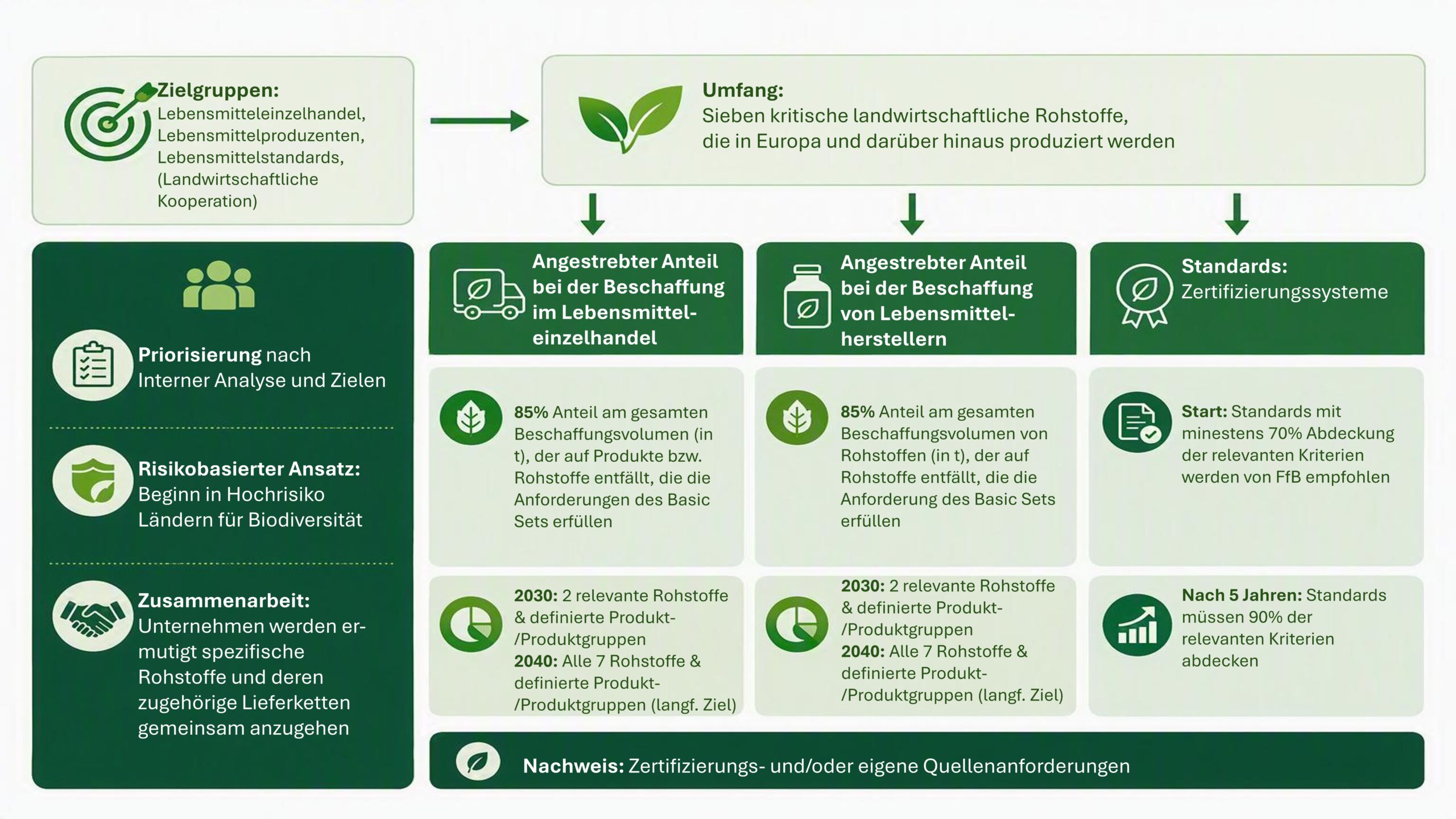
The roll-out strategy now outlines the next step: moving forward by addressing each supply chain individually, aiming to create significant leverage for biodiversity conservation. The commitment to apply the criteria of the Basic Set to the production of relevant raw materials is thus systematically implemented throughout specific supply chains. This strategy provides a framework and clear guidelines to enable the Food for Biodiversity association to set and communicate ambitious, measurable goals. At the same time, it offers enough flexibility to its members to account for individual plans and specific circumstances. Figure 1 presents a summary of the strategy.
2. Target Groups
The primary objective is to encourage the food and beverage sector in Germany, as well as internationally, to adopt the Basic Set as a foundational requirement of biodiversity performance. Accordingly, implementation efforts extend beyond Food for Biodiversity members and are directed towards all stakeholders within the sector, including retailers, manufacturers, standard-setting organisations, suppliers, and farmers‘ cooperatives. Each stakeholder group has to play their part in the roll-out:
Food and beverage retailers, producers and suppliers are expected to integrate the Basic Set criteria into the supply chains of the risk raw materials. They are encouraged to support farmers within these supply chains to enhance on-farm biodiversity performance, providing assistance through financial and other incentives, training, and extension services. All actors along shared supply chains are encouraged to cooperate to identify and implement solutions jointly. Food for Biodiversity will gather practical approaches for individual company-specific programmes that support the financing of improved biodiversity performance. These recommendations are non-binding and can be adapted by companies according to their respective supply chain contexts and implementation capacities.
Standard-setting organisations play a central role by certifying producers of risk raw materials that comply with the Basic Set criteria, thus facilitating wider adoption throughout the sector. Another crucial aspect is capacity building, e.g., supporting farmers in the practical implementation of the standards, as well as providing targeted training on biodiversity. Through capacity building and individual guidelines, or by providing experts, farmers are empowered to effectively and continuously implement biodiversity-promoting measures.
Business associations, environmental non-governmental organisations, and scientific institutions offer their expertise and communication resources to advance the adoption and implementation of the Basic Set.
Farmer cooperatives are encouraged to align with the Basic Set criteria and implement relevant biodiversity measures, recognising the vital role that farmers play in preserving biodiversity.
3. Risk Raw Materials
The Basic Set roll-out will be focused on a group of seven risk raw materials that have been selected by Food for Biodiversity and its members. The selected risk raw materials cover the following:
- Vegetables*
- Fruits**
- Wheat
- Rapeseed
- Sugar Beet
- Dairy***
- Meat***
* = Subgroups include fruit vegetables; root, tuber, onion vegetables; leafy, stem vegetables; cabbage vegetables; ** = subgroups include pome, stone fruit, strawberries, soft fruit, citrus fruit; *** main focus fodder: maize, wheat, rapeseed, soya
4. Steps for the Roll-out
4.1. Scope of the Basic Set
The term „Basic Set“ always refers to the current document of the published Basic Sets. Currently, the 2nd edition of the Basic Set Europe is meant (Basic Set Biodiversity Criteria for the Food Sector – Basic Set for temperate regions (Europe, 2nd Edition)).
The Basic Set covers supply chains for the defined seven risk raw materials, focusing on producers and suppliers in temperate regions (see Appendix 1 for details). It applies solely to agricultural production and excludes processing or other value chain stages. To achieve effective biodiversity protection, enhancement and restoration, the Basic Set criteria should be applied to the entire farm. If a standard certifies on crop-level, criteria for general practices, such as the Biodiversity Action Plan, should be valid for the whole farm.
4.2. Specification of the Basic Set (Commodity Basic Sets)
In 2026, Food for Biodiversity will develop six Basic Sets tailored to specific raw materials. The six commodities have been selected from a list of seven risk raw materials. Some of these commodities currently have a low standard coverage. Here, the aim is to improve existing standards or even motivate standard-setting organisations to create a standard based on the raw material-specific Basic Sets.
4.3. Implementation Plans for each Raw Material
Prioritisation: Companies prioritise raw materials according to individual possibilities, the complexity of supply chains and composition of products.
Market Scope: The focus is on products for the German market. An expansion to additional European market countries will be evaluated
Risk-based approach: The roll-out should commence in countries identified as high risk, based on the WWF Biodiversity Risk Filter, Water Risk Filter or similar tools. It is strongly recommended that retailers, along with food and beverage producers, collaborate to initiate activities in these high-risk sourcing regions. Focus should be on products and product groups that have the highest risks for biodiversity (products with the highest raw material shares).
Cooperation: Companies are encouraged to collaboratively address specific raw materials and their associated supply chains. As many organisations share suppliers, a coordinated approach can enhance implementation efforts and yield more effective outcomes for biodiversity.
4.4. Compliance with the Basic Set
Ideally, all criteria of the Basic Set with relevance for the raw material selected are considered.
Standard-setting organisations:
Standard-setting organisations fulfilling at least 70 % of the relevant criteria will be recommended by Food for Biodiversity as an instrument for rolling out the Basic Set of Biodiversity Criteria.
The standard-setting organisations commit to achieve a minimum of 90 % of the relevant Basic Set Criteria after five years. The organisations will provide a plan to Food for Biodiversity on how to achieve this aim. Having reached at least 90 % after 5 years, they will continue to be recommended by Food for Biodiversity for biodiversity-responsible sourcing.
Food and beverage retailers, producers and suppliers:
Companies can use standards recommended by Food for Biodiversity to prove their compliance with the Basic Set.
Companies with their own criteria in their procurement guidelines meet at least 70 % of the relevant Basic Set criteria in 2027 and 90 % by the end of 2030. Companies joining Food for Biodiversity later than 2026 have five years to achieve 90 % of compliance with relevant Basic Set criteria in their procurement guidelines.
Companies that wish to apply the Basic Set to alternative raw materials instead of the seven listed may do so with appropriate justification, subject to approval by the Food for Biodiversity Working Group Roll-out, e.g., through risk analysis.
4.5. Measuring Implementation for Companies
Indicator for retailers:
The indicator is the percentage of the total amount of raw material in the defined scope. If the Basic Set is applied to 85 % of the total procurement volume (mt), these raw materials are considered to be „biodiversity-responsible“ sourced.
Indicator for food and beverage producers and suppliers:
The indicator used is the total volume of purchased raw material categories in the defined scope. If at least 85% of the supply chain are covered, this raw material is considered to be “biodiversity responsibly” sourced.
5. Reporting
Food and beverage producers, retailers, and suppliers are required to present a comprehensive strategy outlining raw material sourcing for product groups, scheduling, and prioritisation details. Each company is accountable for demonstrating adherence to the Basic Set within the agreed timeline. Members must document their activities and outcomes annually following the roll-out documentation guidelines.
Standard-setting organisations are required to report regularly (ideally annually) to Food for Biodiversity on how their standard schemes have been updated in line with the Basic Set criteria.
Protection of sensitive reporting data: Where reported information could allow conclusions about individual sourcing strategies, supplier relationships or company-specific procurement structures, Food for Biodiversity will ensure that any communication or analysis shared within the association or externally is provided only in aggregated and/or anonymised form. Appropriate safeguards will be applied to prevent the exchange of competitively sensitive information between competitors. Reporting to Food for Biodiversity will not include purchasing or sales prices.
6. Objectives
Standard-setting organisations that align with the Basic Set are essential for the food companies to achieve their milestones.
Objectives for food and beverage producers, suppliers, and retailers:
By 2030, food companies are expected to roll out the Basic Set for two relevant raw materials within the scope defined by each company.
The long-term ambition is to apply the Basic Set to all relevant seven raw materials within the scope defined by each company by 2040. Companies participating in Food for Biodiversity are committed to actively developing and supporting the necessary structures to achieve this goal.
The “Strategy for the Roll-out of the Basic Set Temperate Regions for the Promotion of Biodiversity in the Food and Beverage Sector” will be regularly evaluated and adapted if needed.
7. Monitoring of Long-Term Impact
The Basic Set requires standard-setting organisations and companies to conduct monitoring of key biodiversity-related factors and systematically analyse the aggregated data. The key figures and indicators suggested in the Basic Set serve as a guide. But the Basic Set does not specify how to exactly conduct monitoring, and which indicators are the most important ones and should be used.
Today, there exist various monitoring approaches and tools. Standard-setting organisations are working on metrics to collect data and information. Within the EU LIFE Project “Biodiversity Governance and Performance of the Food Sector”, Justus-Liebig University and Food for Biodiversity are working on a framework for monitoring biodiversity in the food sector. This framework will provide recommendations regarding structures, procedures and key data and indicators for effective and practical monitoring. The aim is to contribute to a harmonisation to facilitate data collection, relieve the burden on farmers and allow comparison of monitoring results.
The framework should be ready by the end of 2026. FfB will strongly recommend taking into consideration key data and indicators of the Basic Set of Biodiversity Criteria for monitoring.
8. Towards Biodiversity-Enhancing Framework Conditions
Responsible actors of the food sector and the implementation of the Basic Set cannot alone achieve stopping the loss of biodiversity or even a net gain of biodiversity. Favourable political and economic framework conditions are needed to enable and accelerate the transition towards biodiversity-responsible food systems. Further details on concrete policy measures and enabling conditions are published in a separate political appeal.
The following FfB members commit themselves to implementing the Roll-out Strategy














The following FfB members support the implementation of the Roll-out Strategy









Lebensmittelbranche startet gemeinsamen Fahrplan für mehr Biodiversität
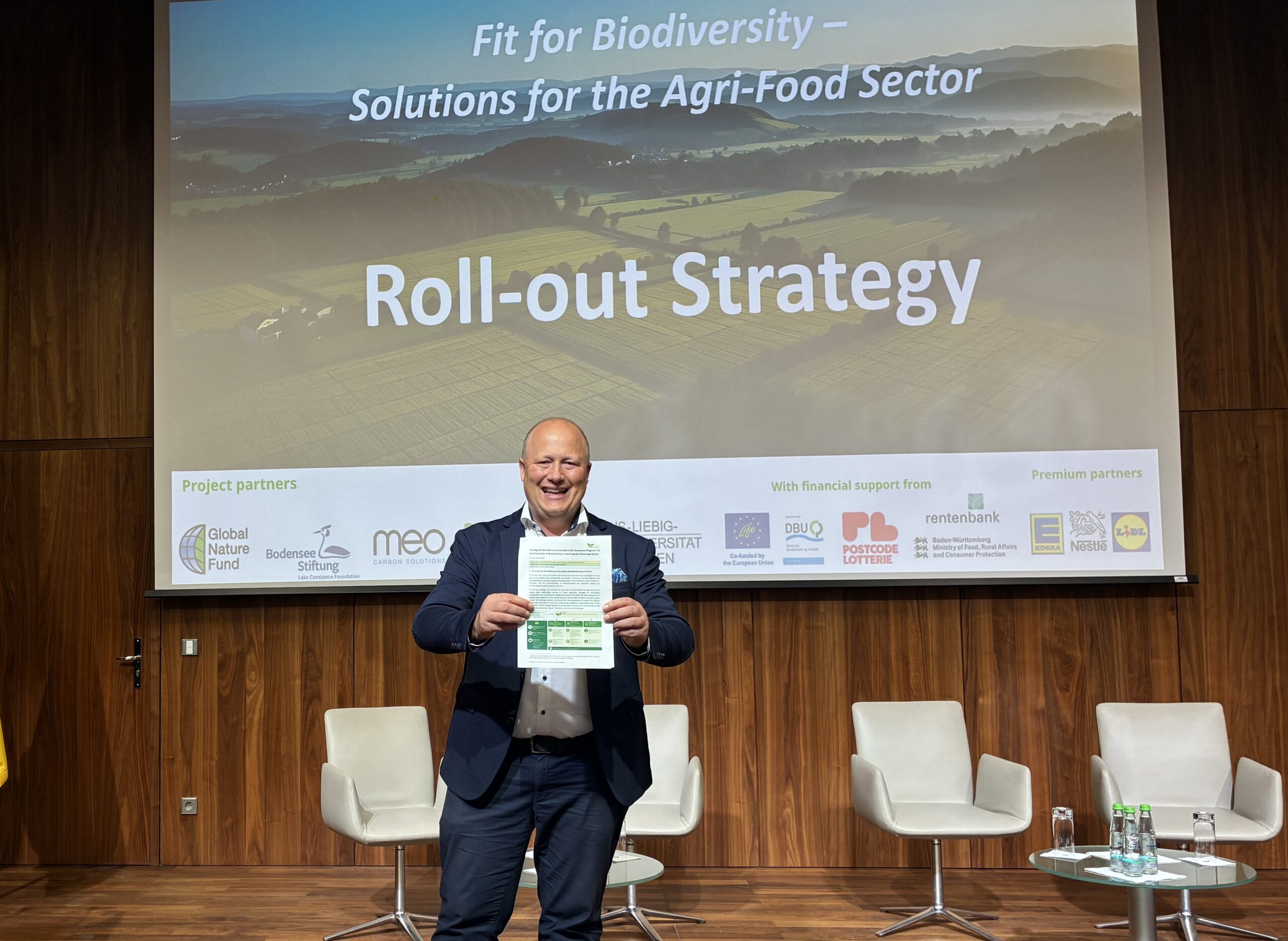
Bonn/Brüssel, 06. Oktober 2026: Die Mitglieder von Food for Biodiversity haben einen gemeinsamen Fahrplan für mehr Biodiversität in landwirtschaftlichen Lieferketten beschlossen, die „Strategy for the Roll-out of the Basic Set Temperate Regions for the Promotion of Biodiversity in the Food and Beverage Sector“. Die Roll-out-Strategie soll dazu beitragen, Biodiversitätskriterien stärker in den Anforderungen von Nachhaltigkeitsstandards sowie in den Beschaffungsvorgaben von Lebensmittel-unternehmen zu verankern.
Grundlage ist das Basis-Set Biodiversitätskriterien für gemäßigte Breiten, das von Food for Biodiversity gemeinsam mit Lebensmittelunternehmen, Standardorganisationen, Umweltorganisationen und der Wissenschaft entwickelt wurde. Es bündelt zentrale Anforderungen zum Schutz und zur Förderung der biologischen Vielfalt in der landwirtschaftlichen Produktion. Unternehmen und Standardorganisationen dient das Basis-Set als gemeinsamer Orientierungsrahmen. Die Roll-out-Strategie sowie die Weiterentwicklung des Basis-Sets sind Teil des EU-LIFE-Projekts Fit for Biodiversity.
„Fünf Jahre nach Vereinsgründung hat Food for Biodiversity in der Lebensmittelbranche Fuß gefasst“, sagt Peter Zens, Vorsitzender von Food for Biodiversity. „Mit der Verabschiedung der Roll-out-Strategie zeigen wir einen Weg auf, um Biodiversitätskriterien strukturiert im Beschaffungsprozess von Lebensmittel-unternehmen zu berücksichtigen. Unter anderem werden mehr naturnahe Habitate eingerichtet und besser geschützt und landwirtschaftliche Praktiken verbessert. “
Konkrete Ziele für die schrittweise Umsetzung
Die Umsetzung konzentriert sich auf sieben Risikorohstoffgruppen der Landwirtschaft in gemäßigten Breiten: Gemüse, Obst, Weizen, Raps, Zuckerrüben, Milch und Fleisch. Für den schrittweisen Roll-out können Unternehmen zunächst entsprechend ihrer Beschaffungsstrukturen und der Komplexität ihrer Lieferketten priorisieren, mit welchen Rohstoffgruppen sie beginnen.
Alle Mitglieder des Vereins stehen hinter der Strategie. Standardorganisationen und Unternehmen haben mit der Umsetzung der Roll-out Strategie für gemäßigte Breiten eine besondere Rolle.
Bis 2030 sieht die Strategie vor, die Biodiversitätskriterien des Basis-Sets für mindestens zwei der sieben Risikorohstoffgruppen umzusetzen. Als Zielgröße gelten mindestens 85 Prozent des Beschaffungsvolumens der ausgewählten Rohstoffgruppe für Eigenmarkenprodukte. Das Beschaffungsvolumen kann sich auf frische Produkte, Säfte, Konserven, Convenience etc. beziehen und wird vom Unternehmen festgelegt. Bis 2040 soll die Anwendung schrittweise auf alle sieben Risikorohstoffgruppen ausgeweitet werden. Food for Biodiversity dokumentiert und verfolgt die Umsetzung der Roll-out Strategie.
Standardorganisationen spielen eine zentrale Rolle bei der Umsetzung. Standards, die mindestens 70 Prozent der für sie relevanten Kriterien des Basis-Sets abdecken, werden von Food for Biodiversity empfohlen. Unternehmen können diese Standards in ihrer Beschaffung nutzen, um die Anforderungen des Basis-Sets zu erfüllen und damit die Roll-out-Strategie umzusetzen. Innerhalb von fünf Jahren soll die Übereinstimmung der Standards mit dem Basis-Set auf mindestens 90 Prozent steigen.
Über Fit for Biodiversity – das Projekt
Das EU-LIFE-Projekt Fit for Biodiversity – Biodiversity Governance and Performance in the Food Sector hat sich zum Ziel gesetzt, die Biodiversitätsleistung im Lebensmittelsektor zu verbessern und wirksame Strategien zum Schutz von Ökosystemen zu entwickeln. Fit for Biodiversity unterstützt Unternehmen der Agrar- und Ernährungswirtschaft dabei, Biodiversitätsrisiken zu erkennen, wirksame Maßnahmen umzusetzen und Biodiversität systematisch in Unternehmens- und Lieferkettenstrategien zu integrieren.
Das Projekt wird kofinanziert durch das LIFE-Programm der Europäischen Union, die Deutsche Bundesstiftung Umwelt (DBU), das Ministerium für Ernährung, Ländlichen Raum und Verbraucherschutz Baden-Württemberg, die Rentenbank, die Postcode Lotterie sowie die Premiumpartner Nestlé Deutschland, EDEKA und Lidl.