
Political Appeal: Embedding Biodiversity in Food Supply Chains
The appeal addresses political decision-makers at the German federal and state levels, and at the European level
The ongoing loss of biodiversity not only threatens ecosystems, but increasingly also the economic foundations of food production. Healthy soils, stable water systems and functioning pollination services are not ecological add-ons, but key production factors. Without them, yields, quality and security of supply cannot be guaranteed in the long term. Against this background, food manufacturers and retailers, standards organisations, environmental organisations and scientific institutions have joined forces as members of the Food for Biodiversity association. Together, we are pursuing a clear objective: to integrate biological diversity (biodiversity) systematically and comprehensively into food supply chains.
With the Strategy for the Roll-out of the Basic Set Temperate Regions for the Promotion of Biodiversity in the Food and Beverage Sector [1], we are now taking the decisive step from pilot projects to broad-scale implementation. Our members are making voluntary commitments by integrating biodiversity criteria as binding requirements into procurement guidelines, supplier relationships and the selection and further development of standards for sustainable agriculture. The roll-out of the Basic Set for tropical and subtropical regions is to be adopted as a next step by the end of 2026.
Our Commitment to Biodiversity-Responsible Procurement
The Basic Set translates shared objectives into concrete requirements for practice and creates a common basis for the development of biodiversity protection along the supply chain. It focuses on key levers with demonstrable impact, such as creating habitats for biodiversity, protecting water bodies, providing alternatives to the use of chemical pesticides and promoting soil health.
By integrating these requirements into standards and procurement processes, biodiversity measures are transferred from pilot initiatives into regular commodity flows and scaled up. The Basic Set therefore provides a practice-tested foundation for integrating biodiversity requirements into funding, reporting and procurement systems.
The food sector is ready to take responsibility and go beyond minimum legal requirements. Voluntary commitments are not a substitute for regulation, but a key implementation mechanism. Policymakers can help increase their effectiveness by creating incentives, defining minimum requirements, safeguarding impact and facilitating wide-scale implementation.
Supportive Political Framework Conditions
We call on political decision-makers at national and European level to specifically strengthen and incentivise voluntary commitments by food companies, and to adequately and reliably reward the contributions made by farms to the development of protecting biodiversity:
- Recognise Biodiversity as an Investment
Measures to protect biodiversity contribute to the long-term safeguarding of production foundations, as well as to risk reduction and the stabilisation of supply chains. Biodiversity protection measures must therefore be more strongly recognised and treated as investments in resilience and security of supply. This perspective must be firmly embedded in funding logics, assessment frameworks and political objectives. Investments in biodiversity should be recognised for tax purposes and placed on an equal footing with other precautionary and future-oriented investments. Special investments in biodiversity should receive tax benefits. Improved financing conditions are also needed, for example through targeted credit offers that take biodiversity services into account.
- Targeted Support for Ambitious Voluntary Measures
Particularly ambitious and effective biodiversity measures are not sufficiently addressed under the current funding framework. Funding programmes are often designed on the basis of area or individual measures rather than being consistently geared towards demonstrable impact. As a result, there are too few incentives to go beyond minimum legal requirements.
Public funds — particularly under the CAP — must be consistently aligned with demonstrably effective biodiversity services. Higher levels of performance must be rewarded much more clearly. Reliable, long-term funding conditions, a clear focus on particularly effective measures and significantly simplified access conditions for farms are required.
At the same time, the legal framework must be designed in such a way that public funding and private premiums along the supply chain can be combined in a targeted manner. Such public-private co-financing opens up additional sources of funding and makes ambitious biodiversity measures economically viable and more attractive for farms.
Moreover, the economic burden must not rest solely on agriculture. A fair distribution of costs and targeted incentive systems along the entire value chain are required, for example through premium models, stronger involvement of the food sector and improved financing conditions. There is a particular need for support for concrete area-based measures in agricultural production, such as a minimum share of 10% semi-natural or natural habitats and 10-metre buffer strips along permanent watercourses.
- Recognise and Reward Voluntary Engagement in Regulatory Frameworks
Food companies that implement ambitious biodiversity requirements currently benefit only to a limited extent, for example due to insufficient consideration in sustainability reporting, due diligence reporting or the EU taxonomy. Voluntary action works best in the long term when it pays off. We are therefore not calling for regulation for its own sake, but for targeted framework conditions that reward frontrunners and do not give free riders an advantage.
Against this background, voluntary standards — such as those used in organic agriculture or those with ambitious biodiversity criteria — should be taken into account in regulatory frameworks, for example through the recognition of existing certifications in control and verification procedures or by linking standards to tax incentives.
Certifications could also be recognised as proof of compliance with certain requirements in funding or support systems, for example under the CAP. This would create effective incentives for measures that protect and promote biodiversity without the need to establish additional control systems.
- Ensure Policy Coherence and Planning Certainty
Different requirements arising from agricultural policy, environmental law, sustainability reporting and supply chain regulation lead to high transaction costs and planning uncertainty, particularly for farms. These hurdles not only slow down the willingness of stakeholders to act, but also limit the impact of voluntary solutions.
To address this, political requirements from environmental, agricultural and economic policy must be consistently aligned. Binding and coherent framework conditions are needed, along with clear long-term development pathways that enable food companies and farms to make reliable investment decisions. We offer Food for Biodiversity’s expertise to work in partnership with political decision-makers on comprehensive solutions.
- Embed Ambitious Standards in Public Procurement
Public procurement currently provides very few incentives for biodiversity-responsible farming practices. Biodiversity criteria are either not embedded in procurement guidelines or play only a minor role, meaning that ambitious standards do not receive a systematic market advantage. As a result, important demand signals that would be necessary to trigger investment in biodiversity along the value chain are missing.
Public procurement must be used strategically as a lever for biodiversity. Procurement guidelines should require a binding minimum share of the standards recommended by Food for Biodiversity in procurement. One option would also be to involve the interministerial working group on sustainable public procurement. This would send clear market signals and create investment certainty.
Conclusion: Making Voluntary Action Effective
As an industry association, we are committed to protecting biodiversity along our supply chains. With the roll-out of the Basic Set, we have set ourselves an ambitious, measurable and scalable voluntary commitment, including concrete time-bound targets for biodiversity-responsible procurement of high-risk raw materials. As part of this, ten member standards of Food for Biodiversity are already recommended for biodiversity-responsible procurement. The substantive solutions are available, and there is willingness to implement them in business and civil society. What is now needed is a political framework that does not disadvantage frontrunners and that rewards impact. We ask the committee to take the measures set out here into account in the ongoing discussions on CAP implementation and sustainability reporting.
Disclaimer: This political appeal was developed within the framework of Food for Biodiversity e.V. and reflects the consensus reached by the member organisations involved in its development. While it represents the shared position of the network, individual member organisations may hold different views on specific aspects or details.
Strategy for the Roll-out of the Basic Set Temperate Regions
1. Concept for the Roll-out of the Basic Set Biodiversity Criteria
The biodiversity criteria of the Basic Set should be comprehensively considered to make agricultural supply chains ‘biodiversity responsible’. The focus is on raw materials with high relevance for the food industry and biodiversity. The prioritisation of raw materials, a schedule, and the documentation of implementation are important aspects for transitioning from pilot projects to roll-out.
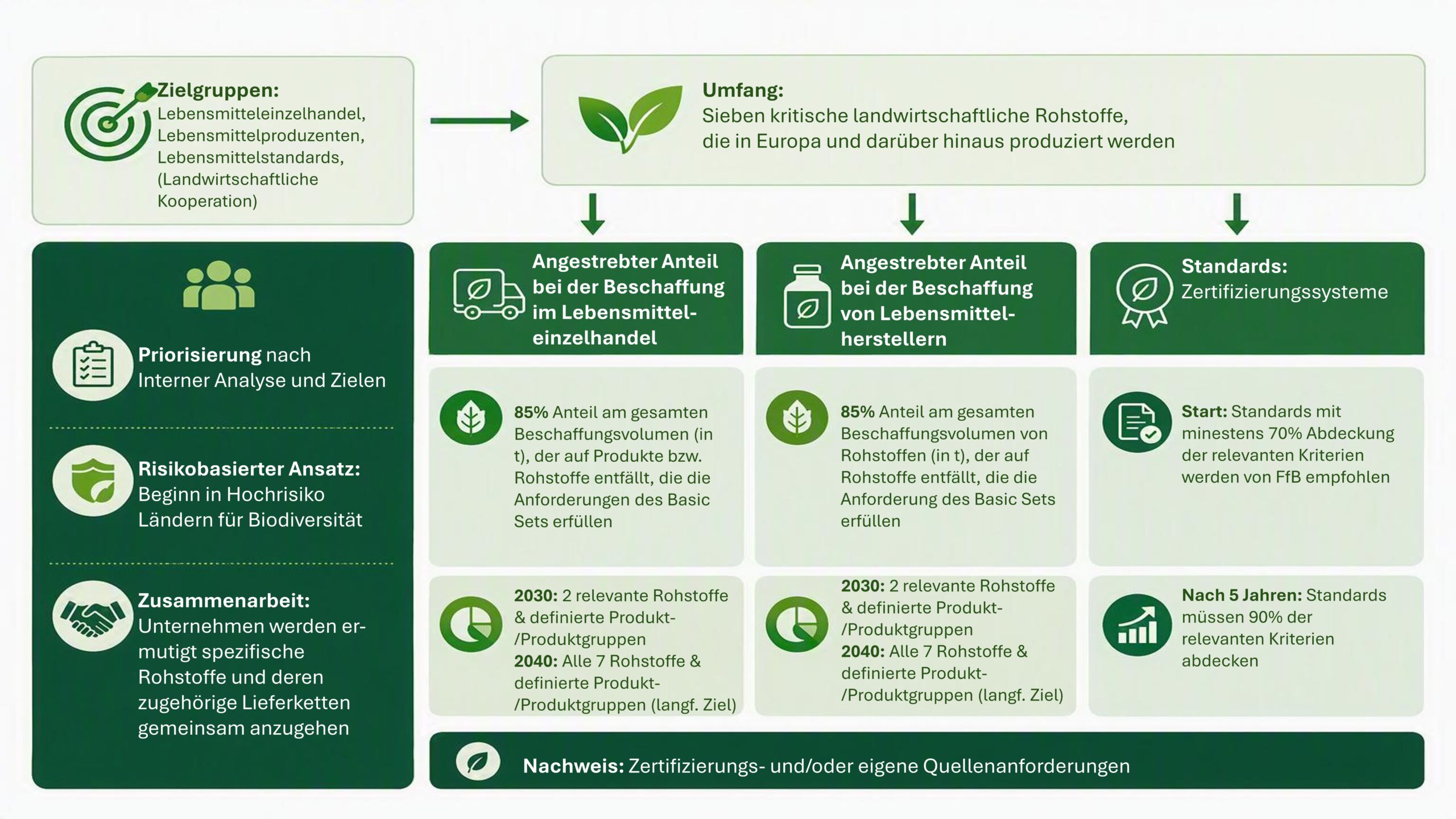
The roll-out strategy now outlines the next step: moving forward by addressing each supply chain individually, aiming to create significant leverage for biodiversity conservation. The commitment to apply the criteria of the Basic Set to the production of relevant raw materials is thus systematically implemented throughout specific supply chains. This strategy provides a framework and clear guidelines to enable the Food for Biodiversity association to set and communicate ambitious, measurable goals. At the same time, it offers enough flexibility to its members to account for individual plans and specific circumstances. Figure 1 presents a summary of the strategy.
2. Target Groups
The primary objective is to encourage the food and beverage sector in Germany, as well as internationally, to adopt the Basic Set as a foundational requirement of biodiversity performance. Accordingly, implementation efforts extend beyond Food for Biodiversity members and are directed towards all stakeholders within the sector, including retailers, manufacturers, standard-setting organisations, suppliers, and farmers’ cooperatives. Each stakeholder group has to play their part in the roll-out:
Food and beverage retailers, producers and suppliers are expected to integrate the Basic Set criteria into the supply chains of the risk raw materials. They are encouraged to support farmers within these supply chains to enhance on-farm biodiversity performance, providing assistance through financial and other incentives, training, and extension services. All actors along shared supply chains are encouraged to cooperate to identify and implement solutions jointly. Food for Biodiversity will gather practical approaches for individual company-specific programmes that support the financing of improved biodiversity performance. These recommendations are non-binding and can be adapted by companies according to their respective supply chain contexts and implementation capacities.
Standard-setting organisations play a central role by certifying producers of risk raw materials that comply with the Basic Set criteria, thus facilitating wider adoption throughout the sector. Another crucial aspect is capacity building, e.g., supporting farmers in the practical implementation of the standards, as well as providing targeted training on biodiversity. Through capacity building and individual guidelines, or by providing experts, farmers are empowered to effectively and continuously implement biodiversity-promoting measures.
Business associations, environmental non-governmental organisations, and scientific institutions offer their expertise and communication resources to advance the adoption and implementation of the Basic Set.
Farmer cooperatives are encouraged to align with the Basic Set criteria and implement relevant biodiversity measures, recognising the vital role that farmers play in preserving biodiversity.
3. Risk Raw Materials
The Basic Set roll-out will be focused on a group of seven risk raw materials that have been selected by Food for Biodiversity and its members. The selected risk raw materials cover the following:
- Vegetables*
- Fruits**
- Wheat
- Rapeseed
- Sugar Beet
- Dairy***
- Meat***
* = Subgroups include fruit vegetables; root, tuber, onion vegetables; leafy, stem vegetables; cabbage vegetables; ** = subgroups include pome, stone fruit, strawberries, soft fruit, citrus fruit; *** main focus fodder: maize, wheat, rapeseed, soya
4. Steps for the Roll-out
4.1. Scope of the Basic Set
The term “Basic Set” always refers to the current document of the published Basic Sets. Currently, the 2nd edition of the Basic Set Europe is meant (Basic Set Biodiversity Criteria for the Food Sector – Basic Set for temperate regions (Europe, 2nd Edition)).
The Basic Set covers supply chains for the defined seven risk raw materials, focusing on producers and suppliers in temperate regions (see Appendix 1 for details). It applies solely to agricultural production and excludes processing or other value chain stages. To achieve effective biodiversity protection, enhancement and restoration, the Basic Set criteria should be applied to the entire farm. If a standard certifies on crop-level, criteria for general practices, such as the Biodiversity Action Plan, should be valid for the whole farm.
4.2. Specification of the Basic Set (Commodity Basic Sets)
In 2026, Food for Biodiversity will develop six Basic Sets tailored to specific raw materials. The six commodities have been selected from a list of seven risk raw materials. Some of these commodities currently have a low standard coverage. Here, the aim is to improve existing standards or even motivate standard-setting organisations to create a standard based on the raw material-specific Basic Sets.
4.3. Implementation Plans for each Raw Material
Prioritisation: Companies prioritise raw materials according to individual possibilities, the complexity of supply chains and composition of products.
Market Scope: The focus is on products for the German market. An expansion to additional European market countries will be evaluated
Risk-based approach: The roll-out should commence in countries identified as high risk, based on the WWF Biodiversity Risk Filter, Water Risk Filter or similar tools. It is strongly recommended that retailers, along with food and beverage producers, collaborate to initiate activities in these high-risk sourcing regions. Focus should be on products and product groups that have the highest risks for biodiversity (products with the highest raw material shares).
Cooperation: Companies are encouraged to collaboratively address specific raw materials and their associated supply chains. As many organisations share suppliers, a coordinated approach can enhance implementation efforts and yield more effective outcomes for biodiversity.
4.4. Compliance with the Basic Set
Ideally, all criteria of the Basic Set with relevance for the raw material selected are considered.
Standard-setting organisations:
Standard-setting organisations fulfilling at least 70 % of the relevant criteria will be recommended by Food for Biodiversity as an instrument for rolling out the Basic Set of Biodiversity Criteria.
The standard-setting organisations commit to achieve a minimum of 90 % of the relevant Basic Set Criteria after five years. The organisations will provide a plan to Food for Biodiversity on how to achieve this aim. Having reached at least 90 % after 5 years, they will continue to be recommended by Food for Biodiversity for biodiversity-responsible sourcing.
Food and beverage retailers, producers and suppliers:
Companies can use standards recommended by Food for Biodiversity to prove their compliance with the Basic Set.
Companies with their own criteria in their procurement guidelines meet at least 70 % of the relevant Basic Set criteria in 2027 and 90 % by the end of 2030. Companies joining Food for Biodiversity later than 2026 have five years to achieve 90 % of compliance with relevant Basic Set criteria in their procurement guidelines.
Companies that wish to apply the Basic Set to alternative raw materials instead of the seven listed may do so with appropriate justification, subject to approval by the Food for Biodiversity Working Group Roll-out, e.g., through risk analysis.
4.5. Measuring Implementation for Companies
Indicator for retailers:
The indicator is the percentage of the total amount of raw material in the defined scope. If the Basic Set is applied to 85 % of the total procurement volume (mt), these raw materials are considered to be “biodiversity-responsible” sourced.
Indicator for food and beverage producers and suppliers:
The indicator used is the total volume of purchased raw material categories in the defined scope. If at least 85% of the supply chain are covered, this raw material is considered to be “biodiversity responsibly” sourced.
5. Reporting
Food and beverage producers, retailers, and suppliers are required to present a comprehensive strategy outlining raw material sourcing for product groups, scheduling, and prioritisation details. Each company is accountable for demonstrating adherence to the Basic Set within the agreed timeline. Members must document their activities and outcomes annually following the roll-out documentation guidelines.
Standard-setting organisations are required to report regularly (ideally annually) to Food for Biodiversity on how their standard schemes have been updated in line with the Basic Set criteria.
Protection of sensitive reporting data: Where reported information could allow conclusions about individual sourcing strategies, supplier relationships or company-specific procurement structures, Food for Biodiversity will ensure that any communication or analysis shared within the association or externally is provided only in aggregated and/or anonymised form. Appropriate safeguards will be applied to prevent the exchange of competitively sensitive information between competitors. Reporting to Food for Biodiversity will not include purchasing or sales prices.
6. Objectives
Standard-setting organisations that align with the Basic Set are essential for the food companies to achieve their milestones.
Objectives for food and beverage producers, suppliers, and retailers:
By 2030, food companies are expected to roll out the Basic Set for two relevant raw materials within the scope defined by each company.
The long-term ambition is to apply the Basic Set to all relevant seven raw materials within the scope defined by each company by 2040. Companies participating in Food for Biodiversity are committed to actively developing and supporting the necessary structures to achieve this goal.
The “Strategy for the Roll-out of the Basic Set Temperate Regions for the Promotion of Biodiversity in the Food and Beverage Sector” will be regularly evaluated and adapted if needed.
7. Monitoring of Long-Term Impact
The Basic Set requires standard-setting organisations and companies to conduct monitoring of key biodiversity-related factors and systematically analyse the aggregated data. The key figures and indicators suggested in the Basic Set serve as a guide. But the Basic Set does not specify how to exactly conduct monitoring, and which indicators are the most important ones and should be used.
Today, there exist various monitoring approaches and tools. Standard-setting organisations are working on metrics to collect data and information. Within the EU LIFE Project “Biodiversity Governance and Performance of the Food Sector”, Justus-Liebig University and Food for Biodiversity are working on a framework for monitoring biodiversity in the food sector. This framework will provide recommendations regarding structures, procedures and key data and indicators for effective and practical monitoring. The aim is to contribute to a harmonisation to facilitate data collection, relieve the burden on farmers and allow comparison of monitoring results.
The framework should be ready by the end of 2026. FfB will strongly recommend taking into consideration key data and indicators of the Basic Set of Biodiversity Criteria for monitoring.
8. Towards Biodiversity-Enhancing Framework Conditions
Responsible actors of the food sector and the implementation of the Basic Set cannot alone achieve stopping the loss of biodiversity or even a net gain of biodiversity. Favourable political and economic framework conditions are needed to enable and accelerate the transition towards biodiversity-responsible food systems. Further details on concrete policy measures and enabling conditions are published in a separate political appeal.
The following FfB members commit themselves to implementing the Roll-out Strategy











The following FfB members support the implementation of the Roll-out Strategy









Biodiversity-Responsible Procurement Needs Orientation
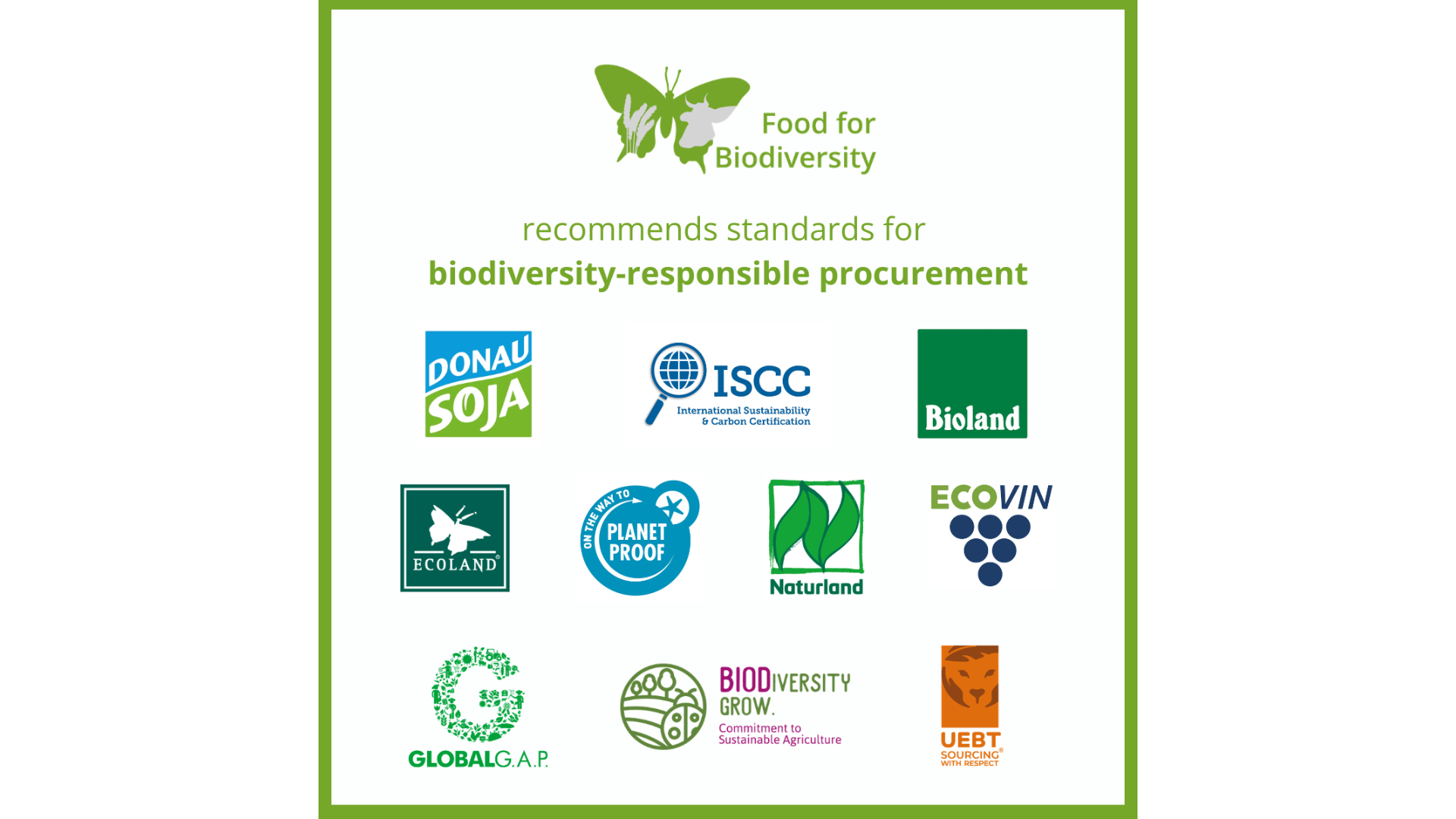
Ten standards engaged at Food for Biodiversity already meet more than 70% of the criteria in the core set of biodiversity criteria that are relevant to them. In doing so, they make a significant contribution to the protection of biodiversity and provide companies with guidance and planning certainty in their procurement activities.
Based on this, Food for Biodiversity recommends the following standards for biodiversity-responsible procurement:
- Donau Soja (Guidelines, January 2024)
- ISCC PLUS (Version 3.4.2)
- Naturland (Production Guidelines, as of May 2024, as well as supplementary biodiversity measures)
- Bioland (Guidelines, adopted on November 18/19, 2024)
- Ecoland (Guidelines, as of January 2024)
- On the Way to PlanetProof (Plant Products, Version 5)
- ECOVIN (Guidelines, 17th Edition dated April 8, 2024)
- GLOBALG.A.P. IFA v6 (Version 6 Smart)
- BioDiversity Grow (Standard, Version 14, November 2025)
- UEBT – Sourcing with Respect (2020 Standard and associated Field Checklists)
The Basic Set of Biodiversity Criteria
The biodiversity criteria in the Basic Set Europe were systematically compared with the requirements of the member standards. The Basic Set serves as a technical reference framework for the food industry and helps companies and standards assess, further develop, and enhance the effectiveness of existing biodiversity requirements.
The criteria focus in particular on agricultural production and cover key areas of action, including:
- Development and implementation of Biodiversity Action Plans at the farm level
- Measures to promote and connect near-natural habitats
- Requirements for soil management and plant protection
- Training and continuing education in the field of biodiversity
Objectives
With its Basic Set, Food for Biodiversity is not seeking to introduce a new label. Instead, the focus is on further developing and strengthening existing standards in order to achieve the broadest possible impact on biodiversity in the food sector’s supply chains.
New Pilot Project: Biodiversity as an Opportunity for Agriculture
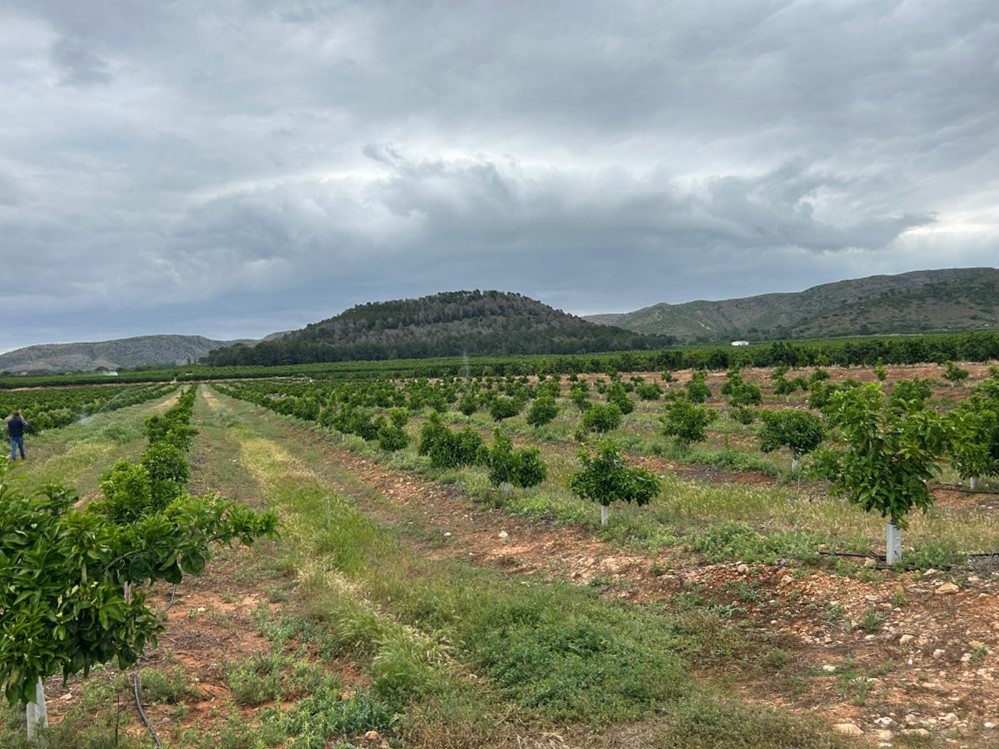
A new pilot project in Spain is testing a practical system for recording biodiversity and environmental indicators across 157 hectares of cultivated land. More than 30 indicators are being measured on fruit and vegetable farms—from soil life and beneficial organism populations to carbon footprint.
The project is being implemented by Biodiversity Grow / Quality and Adviser (coordination), GLOBALG.A.P., and the Global Nature Fund. It supports the development of the new GLOBALG.A.P. standard Sustainable Environmental Solutions (ESS), scheduled for release at the end of 2025, and incorporates the biodiversity criteria of the Food for Biodiversity initiative.
The goal is to make biodiversity measurable—and to use it as a strategic advantage for more sustainable and future-oriented agriculture.

Biodiversity: New Legal Requirements for Food Companies
An assessment by the Chairwoman of the Food for Biodiversity association, Marion Hammerl, on current legal requirements for food companies and helpful tools for their fulfillment.